By Wahome Ngatia
Peter Aluoch insists he joined Self Help Africa (SHA) as an intern. He says it almost casually, with the kind of disarming modesty that makes you pause—especially when you learn he holds a PhD from the Catholic University of Murcia (UCAM) in Spain and a Master’s degree from the Royal Agricultural University in England. Titles, it seems, matter far less to him than outcomes.
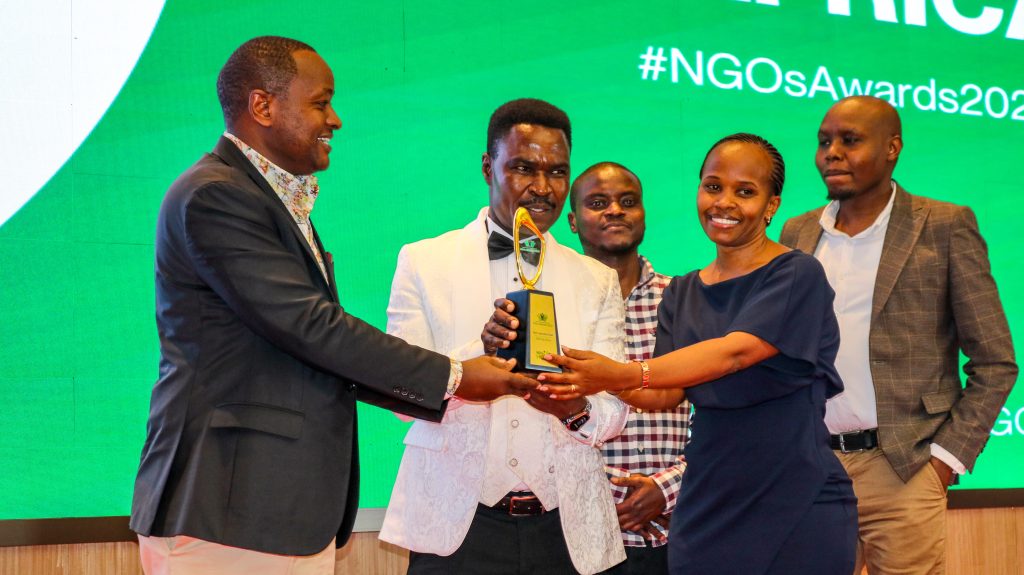
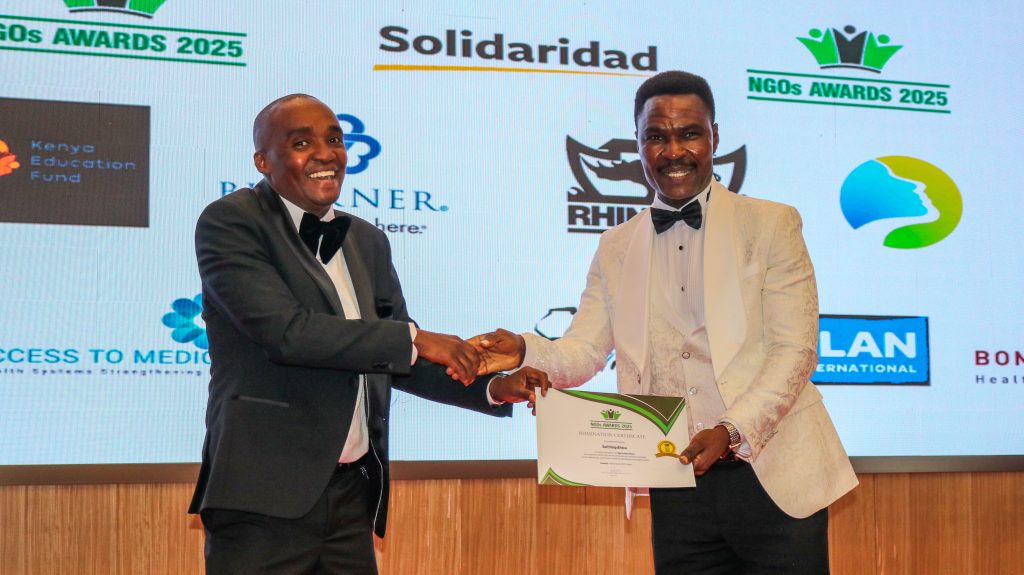
Now the Country Director of SHA Kenya, Aluoch rarely answers to “Dr.” Instead, he speaks at length—and with evident pride—about the work his organisation is doing on the ground. That work was compelling enough to earn SHA the NGO Awards 2025 Best in Agriculture, a recognition Aluoch wears unapologetically.
“Every email I write has the NGO Awards 2025 winner sticker,” he says, smiling. “It’s on our website and all our platforms. Everybody needs to know how much this means to us.”
Step into his office and you will immediately understand why. The NGO Awards trophy sits prominently on his desk, not as a vanity piece but as a symbol—of grit, innovation, and the courage to operate where even government systems often struggle to reach.
At the heart of Aluoch’s vision is a bold but practical idea: Kenya should be able to feed itself. He is particularly animated when discussing maize imports and the untapped potential of alternative crops.
“Kenya imports about 28 million metric tonnes of maize,” he notes. “Yet cassava has a higher starch content and can grow in tough conditions. It’s resilient. If we build farmer capacity and link them to markets, we wouldn’t need to import at the levels we do.”
How it all began
Aluoch’s journey with SHA began far from Kenya, at a London Agricultural Society forum in England, where he was presenting his PhD research on integrating smallholder farmers into enterprise value chains. His presentation caught the attention of a regional SHA director, who asked him to come to Kenya—for just one month—to critique existing enterprise models.
“I shifted the cassava model to focus more on private sector integration,” Aluoch recalls.
He left once the month period was over. But there was a little problem.
No one else could execute the redesigned model quite like the man who built it. He was soon invited back—this time as Country Coordinator for Agribusiness in 2019, then Head of Programmes in 2022, and finally Country Director in early 2024 when the position fell vacant.
Leadership, however, came with its own quiet costs.
“When I was Head of Programmes, I sat with colleagues. Now I spend a lot of time alone in the office,” he admits. To counter that isolation, Aluoch deliberately structures his time so that only 20 per cent is spent behind a desk. The remaining 80 per cent is in the field—meeting farmers, donors and partners.
Strategy under pressure
The transition from programme management to overall leadership, he says, requires a different muscle altogether.
“This role involves a lot of thinking and strategising. When projects end, I have to think about what the next year looks like,” Aluoch explains.
That strategic capacity was tested when USAID funding was withdrawn, wiping out roughly KSh200 million from SHA’s annual turnover. Projects were closed and staff laid off—a painful but defining moment.
Yet the disruption forced diversification. SHA has since strengthened new relationships with other donors Such as Donald Danforth Plant Science Center, the European Union, the UK’s Foreign, Commonwealth & Development Office (FCDO), World Food Programme (WFP) and The Italian Agency for Development Cooperation (AICS). These relationships are expected to raise additional funding to support smallholder farmers in Kenya..
Today, SHA’s donor portfolio reads like a seal of credibility: the European Union, Irish Aid, GIZ, Trademark Africa, World Food Programme, Global Evergreen Alliance, and others.
Innovation at the margins
Challenges persist—slow technology adoption, weak rural connectivity, and limited access to banking services in remote areas. SHA’s response has been characteristically practical: agency banking for farmers, blended financing worth KSh300 million, community-managed water token systems in Baringo, hydroponics in arid counties like Wajir, Isiolo and Makueni.
These interventions, Aluoch insists, are not isolated projects but pieces of a larger puzzle—one aimed at resilient livelihoods and national food security.
Taken together, they explain why SHA’s Agriculture Award felt less like a win and more like a confirmation. Under Peter Aluoch’s quiet but decisive leadership, the organisation is not just growing crops—it is cultivating a future where Kenyan farmers are central to Kenya’s prosperity.